.webp)

.svg)
.svg)

Your entry-level roles are dying. Your talent strategy can’t be.
Your entry-level roles are dying. Your talent strategy can’t be.
Why CEOs, CHROs, and Boards need to rebuild early-career hiring before AI breaks the pipeline.
For decades, entry-level work had a clear purpose. It was how companies got leverage and how people learned the business. New hires did the first pass analysis, the first drafts, the coordination, the research, the screening, the “run the process” work. Then they leveled up.
AI is now taking direct aim at that layer. The World Economic Forum’s Future of Jobs Report 2025 expects the biggest declines in clerical and routine roles, including roles like data entry and other administrative work. The Forum also notes that many employers expect workforce reduction where AI can automate tasks.
Here is the risk most leadership teams are not naming clearly. If entry-level tasks disappear, a lot of companies will quietly stop hiring early-career talent. That may look rational in the short term. It is also how you create a mid-level drought, a culture drift, and a capability gap that you cannot buy your way out of later.
The winning strategy is not to defend old entry-level roles. It is to redesign early-career hiring into an acceleration engine that turns a small number of high-potential hires into mid-level contributors faster than the market can.
We recently spoke with some of the best talent leaders in the world. These conversations covered early career jobs, career paths, and the impact of AI on it all. Together, we discerned three major keys to this puzzle.
Automation is killing tasks, not talent
The practical shift is already visible. Research on generative AI in real workplaces shows that AI tools can raise productivity and change how work is done, often by lifting performance for less experienced workers. A large-scale field study of generative AI support for customer service found a meaningful productivity increase and noted that gains were largest among lower-skilled or newer workers.
That matters because entry-level work has historically been heavy on repeatable tasks. As AI absorbs more of the “first draft” layer, the value of junior talent does not vanish. It changes. Humans move up the stack. They spend less time producing raw output and more time framing the question, judging trade-offs, and interpreting results. McKinsey’s more recent work on AI and work partnerships makes that shift explicit: less time on basic research and document prep, more time on higher-value context and interpretation.
The question is not, “Do we still need entry-level people?” The question is, “What do we want entry-level people to become, and how fast?”
The new entry-level model is smaller, harder, and faster
The Chief People Officer of a global-scale technology company told us about an early-career strategy built on a controversial belief: “We don’t believe in a few years we would need many entry-level roles.” He immediately paired it with the real point: “We need to hire some really amazing entry-level people to develop them into mid-level people that we will need going forward.”
That is the new model: fewer seats, higher bar, faster development. The point of early-career hiring becomes building tomorrow’s mid-level capability inside your operating system, instead of renting it later at market price.
This is not theoretical. WEF projects simultaneous job creation and displacement driven by technology, including AI and information processing. In that kind of churn, the companies that win are the ones that control their pipeline, not the ones that outsource it to the labor market.
The strategic implication for CEOs and Boards is simple. If you stop building early talent because AI took the tasks, you are making a long-term bet that someone else will build the people you need and that you can hire them away later. That is not a talent strategy. That is hope.
Selection is becoming the bottleneck
The pipeline problem is compounded by a second force: volume and noise.
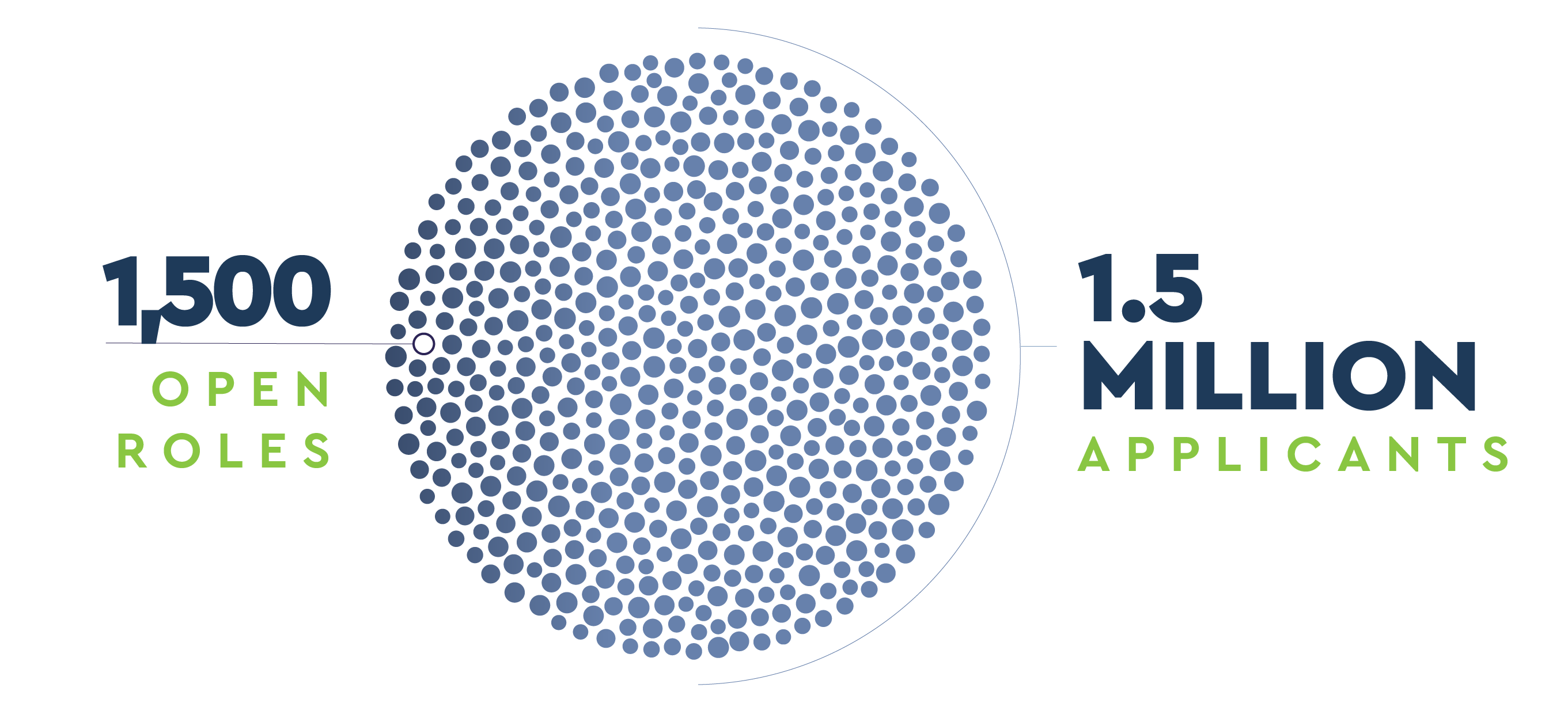
The Chief AdministrativeOfficer of an international media company cited a jaw-dropping scale issue in he market, pointing to the tech sector: “We know of companies that have had1.5 million applicants for 1,500 roles.” This has led to companies conducting their first-round interviews via agentic AI.
At the same time, these conversations surfaced the new fraud problem: AI-assisted interviewing. This isa complicated issue to solve. In some parts of the process, a hiring organization may want to see how candidates use AI well. In other parts, they may explicitly restrict AI and move toward live work sessions, potentially requiring secure interview sites for identity verification and controlled environments.
Here is where this becomes a leadership issue, not an HR issue. If selection breaks, the whole acceleration model breaks. You cannot build a future mid-level bench if you cannot reliably identify learning agility, judgment, and real collaboration.
Research also suggests the early signals may already be showing up in hiring data. A Stanford Digital Economy Lab paper looking at entry-level employment trends reports results consistent with the hypothesis that generative AI has begun to affect entry-level employment, while also cautioning that other factors may contribute. You do not need certainty to act. You need a plan that is resilient under uncertainty.
There is a fair concern here. If companies shrink entry-level hiring, what happens to social mobility and to the next generation of workers?
The best version of this future is not a world with no entry-level opportunities. It is a world where entry-level work is less about grunt tasks and more about capability-building, with better coaching and clearer standards. Reuters captured the same idea from EY’s global vice chair Julie Teigland: companies will not realize AI productivity gains without redesigning roles and investing in training.
In other words, the responsible move is not to cut the bottom rung. It is to rebuild it.
Entry-level roles as we knew them are fading because entry-level tasks are being automated. The strategic mistake is to treat that as permission to stop hiring early-career talent.
The right move is to hire fewer, better, earlier. Then accelerate them aggressively into the mid-level layer your business will depend on.
In the AI era, the best companies will not have the biggest entry-level programs. They will have the fastest ones.
Meet the Author


.webp)


.svg)
.svg)





.webp)