.webp)

.svg)
.svg)

AI won’t replace clinical judgment. But it will expose weak leadership.
AI won’t replace clinical judgment. But it will expose weak leadership.
What healthcare CEOs, CMOs, and CHROs must rethink as AI reshapes how decisions actually get made
For decades, clinical decision-making has followed a familiar hierarchy. Experience sits at the top. Authority reinforces it. Data supports decisions after the fact. When judgment is questioned, it is usually by another human with more tenure, more credentials, or more institutional power.
AI disrupts that order.
Across healthcare, AI systems are now influencing diagnoses, treatment pathways, risk stratification, utilization management, and workforce planning. They surface patterns no individual clinician could see and do it at speed. The promise is better outcomes and more consistent care. The fear is loss of autonomy, ethical ambiguity, and decisions made by systems that clinicians do not fully control.
Most organizations frame this as a technology challenge: model validation, safety testing, regulatory clearance. That framing misses the real issue. AI does not simply introduce new tools. It changes how decisions are formed, challenged, and justified inside clinical and operational teams.
Evidence is more important than authority
When AI enters the room, authority alone no longer carries the argument. Evidence does.
The best outcomes come when AI augments human judgment rather than overrides it. That shift requires leadership to evolve from authority-driven decision-making to evidence-integrated leadership, without surrendering accountability or ethical responsibility.
AI reshapes clinical authority, not by replacing it, but by challenging it. Peer-reviewed research shows that AI systems can match or exceed individual clinician performance in specific, well-defined diagnostic tasks, such as skin cancer classification and image interpretation. These gains are real but narrow. Performance varies by domain, data quality, and study design, and AI systems perform less reliably in novel or ambiguous clinical situations.
This creates a leadership challenge. When an AI model flags a risk a senior clinician disagrees with, the question is no longer who has more experience. It is how the organization adjudicates disagreement responsibly. Health systems that default to hierarchy suppress the value of evidence. Those that succeed redesign decision pathways so human judgment and machine insight are intentionally integrated.
Ethics move from abstract principle to operational reality
AI ethics is often discussed in policy terms: transparency, explainability, bias. In clinical environments, ethics becomes operational. Who is accountable when an AI-informed recommendation causes harm? How is consent handled when clinical advice is partially machine-generated? How do leaders ensure models trained on historical data do not reinforce inequities?
Empirical research has already shown that poorly governed algorithms can embed racial bias at scale, even when designers believe them to be neutral. Ethical leadership in an AI-enabled environment is not a one-time approval decision. It requires continuous oversight, active monitoring, and the willingness to intervene when evidence conflicts with values.

Workforce design must follow decision design
As AI systems take on analytical and pattern-recognition tasks, clinicians are pushed toward higher-order judgment, patient communication, and exception handling. Studies of AI-assisted radiology workflows show that pairing generative AI with human review can improve efficiency without degrading clinical quality—but only when accountability remains explicit.
Evidence also points to a counter-risk. When clinicians over-trust automated recommendations, especially under time pressure, performance can decline when the system is wrong—a well-documented phenomenon known as automation bias. Organizations that fail to redesign roles, incentives, and escalation paths often experience resistance, silent workarounds, or degraded judgment.
Leadership readiness, not model accuracy, becomes the limiting factor.
Humans will still make the critical decisions
Some argue that as AI improves, human oversight will become inefficient or even unsafe, particularly in high-volume or time-sensitive environments. From this view, removing humans from the loop appears inevitable.
The evidence does not support that conclusion. AI systems struggle with edge cases, shifting populations, and value-based tradeoffs. More importantly, trust in healthcare decisions remains social, not statistical. Patients, clinicians, and regulators still expect human accountability. AI can inform decisions at scale. Responsibility does not transfer to the system.
It’s not whether to use AI. It’s how leadership adapts.
The question for healthcare leaders is no longer whether AI belongs in clinical and operational decision-making. That decision is already made. The real question is how leadership adapts when evidence becomes faster, louder, and harder to ignore.
Organizations that cling to authority-driven decision-making will sideline AI or breed resentment. Those that treat AI as an unquestioned arbiter will discover its limits the hard way. The leaders who succeed will redesign decision-making itself—clarifying where AI informs, where humans decide, and how disagreement is resolved.
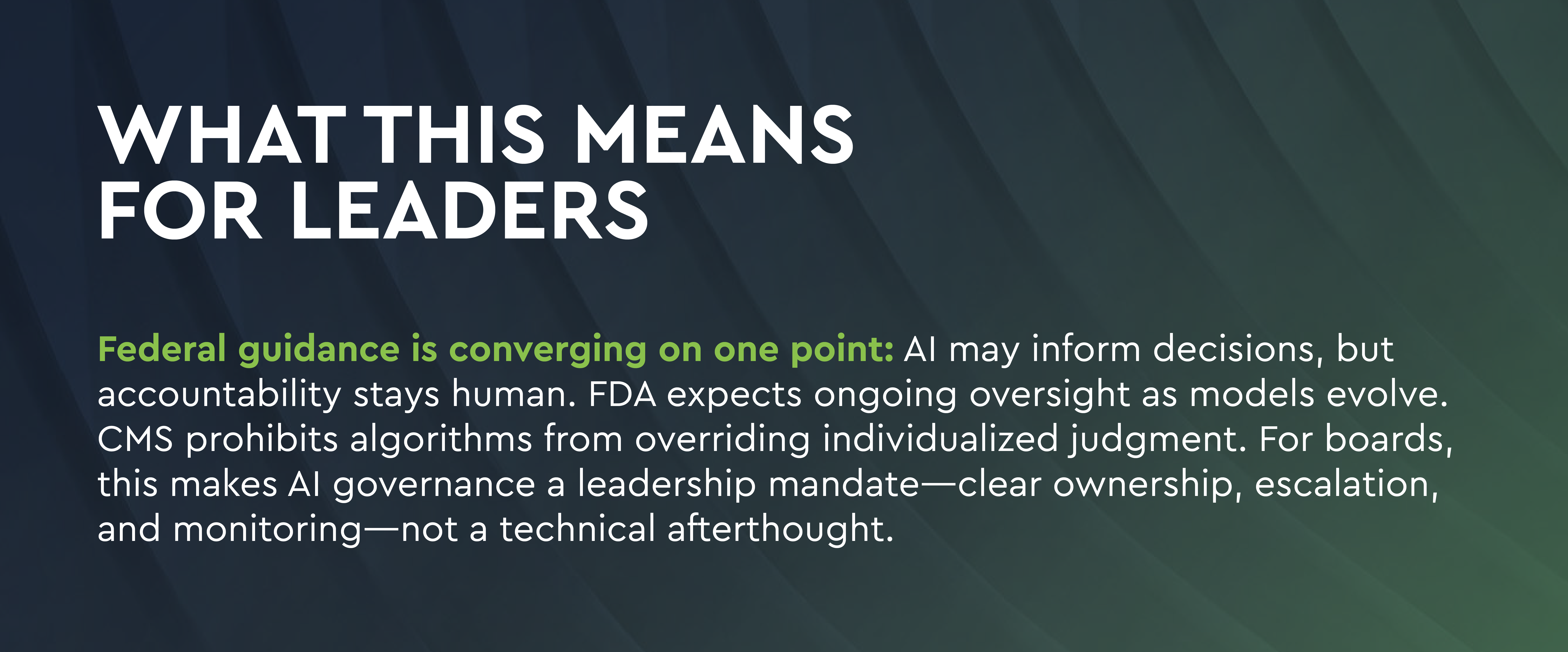
That approach increasingly aligns with regulatory reality. FDA guidance emphasizes continuous oversight as AI models evolve, and CMS has made clear that algorithms may assist, but cannot override individualized clinical judgment.
AI raises the bar for leadership. It does not lower it.
Meet the Author





.svg)
.svg)





.webp)