.webp)

.svg)
.svg)

Search profiles aren’t keeping up with the reality VPs of Research face.
Search profiles aren’t keeping up with the reality VPs of Research face.
For trustees and university presidents rebuilding research strategy under federal funding volatility, the person you hire next will determine whether your institution absorbs the shock or amplifies it.
Walk into almost any senior leadership discussion about the next Vice President for Research, and the conversation still tends to focus on a candidate’s scientific pedigree, research funding portfolio, publication record, and national/international footprint. These criteria are valid, but they don’t always address the gap between the priorities outlined in the position description and the needs of the organization and its culture of innovation and discovery.
The general view across higher education still tends to depict the VPR as a distinguished scientist who is also responsible for administering an office that oversees the success and growth of research. That framing made sense when federal funding was predictable, compliance risk was containable, and public trust in research was largely intact. Most of these conditions do not hold today. Grant pipelines are volatile, regulatory scrutiny is sharper, philanthropic dollars are being asked to carry weight they were never designed to bear, and the institution's reputation now travels at the speed of a single congressional hearing or viral clip.
Our view at ZRG is direct. The VPR role has been quietly rewritten by external pressure, and institutions that recruit against the old profile will inherit the old outcomes. The science and the balance sheet can no longer afford that mismatch.
The job has outgrown the org chart
The modern VPR spends less time inside the lab ecosystem and more time in Washington, in front of donors, and in front of cameras. Federal agency relationships that used to be the province of a government relations office now sit squarely on the research portfolio. Compliance exposure that used to be distributed across general counsel, export control, and human subjects protection now converges on the VPR's desk. The stakes are increasingly financial as well as regulatory. Multiple federal agencies have sought to cap reimbursement for indirect research costs at 15%, placing greater pressure on institutions to demonstrate and defend the infrastructure required to support sponsored research. Reputational risk that used to be handled by communications now demands a research leader who can speak clearly, quickly, and without hedging when a study, a partnership, or a controversy lands in the news cycle.
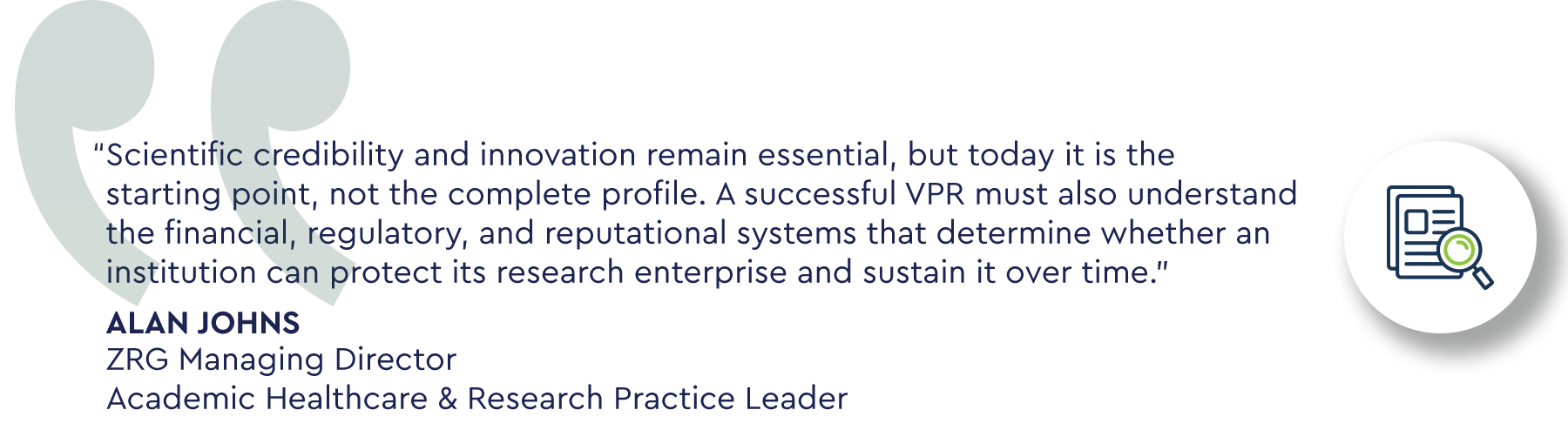
Boards should test candidates on regulatory literacy and public voice with the same rigor they apply to scientific standing. Ask how a candidate would handle a subpoena, a hostile op-ed, or a sudden policy reversal from a major funder. The answers reveal more about readiness than another line on a citation index ever will.
Philanthropy is now a parallel funding system
As federal dollars contract, institutions are turning to individual donors, family offices, and foundations to backfill research capacity. Yet the scale of that substitution has clear limits. Deloitte reports that federal research support remains approximately 10 times larger than philanthropic support: $50 billion compared with $5 billion, based on 2021 funding levels. The Center for American Progress mapped out over 4,000 grants targeted for termination in 2025. The award totals affected exceeded $6Bn. In the same time period, the William T. Grant Foundation saw grant applications triple. Far from being a temporary disruption, this signals a durable shift in how research at scale gets financed, and it changes the internal architecture of research leadership.
The working relationship between the VPR and the Chief Advancement Officer has moved from incidental to strategic. Advancement leaders now need genuine scientific fluency, enough to sit across from a principal donor and explain why a particular platform, center, or investigator deserves a nine-figure commitment. VPRs need real competence in donor cultivation, enough to carry a relationship from first meeting to signed gift agreement without outsourcing the intellectual weight of the conversation.
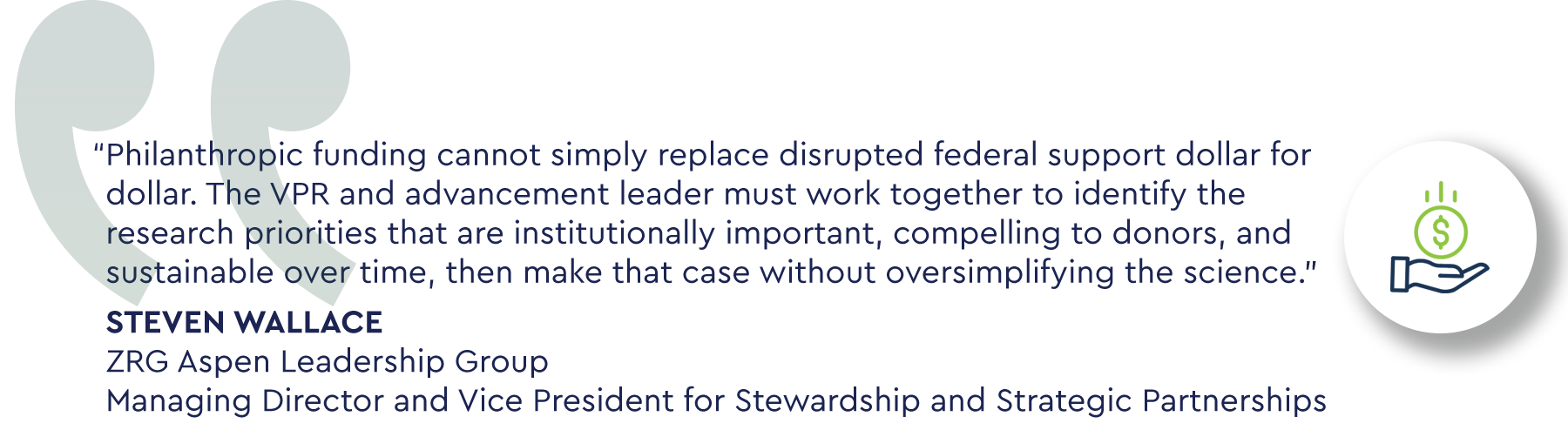
Search committees should evaluate this tandem intentionally rather than sequentially and consider recruiting these two roles in concert. Institutions that hire them in isolation often find themselves rebuilding the partnership eighteen months later under worse conditions.
Interim leadership is a strategic instrument, not a placeholder
Institutions in transition are deploying interim VPRs to stabilize research operations, protect grant pipelines, and give search committees time to recalibrate the permanent profile against a changing landscape. This is not the old model of an interim as a caretaker while the real search plays out. It is a deliberate choice to buy the institution twelve to eighteen months of clarity before making a decade-shaping decision.
Boards have started to recognize a difficult truth. Namely, that a rushed permanent hire against an obsolete specification is more expensive than a well-chosen interim who protects the portfolio and sharpens the profile at the same time.
Some will argue that scientific credibility must remain the anchor requirement, and that broadening the profile risks installing an administrator who cannot command the respect of principal investigators. That concern is legitimate. Scientific standing still matters, and no amount of communications polish substitutes for it. The point is not to trade credibility for versatility. The point is that credibility alone no longer covers the job, and search committees that treat the additional competencies as optional will be selecting from a shrinking pool of people already stretched past their training.
The VPR role has been rewritten in real time while most institutions were still hiring against the old draft. Part scientist, part lobbyist, part risk manager, part communicator: that is the job now, whether the position description says so or not.
Boards and presidents who want research leadership capable of withstanding the next funding shock should do two things before opening a search. First, rewrite the position specification to reflect the four capabilities the role actually requires today, and be honest about which of them your current bench can already provide. Second, decide with clear eyes whether a permanent hire or a strategic interim gives the institution the best runway to make that decision well. The wrong answer here does not just cost a search cycle. It costs research capacity your institution may not recover.
Meet the Author


.webp)
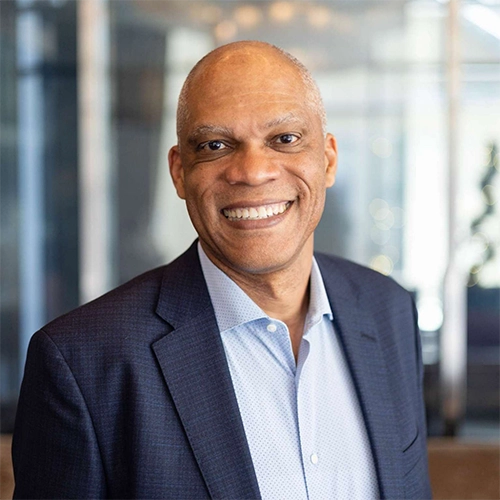
Alan D. Johns
Managing Director
Education and Healthcare
Academic Healthcare and Research Lead


.svg)
.svg)





.webp)