
Accountability is leadership’s biggest weakness. Are we trying to fix it in the wrong place?
New Gallup research identifies creating accountability as leaders’ lowest-rated competency. But the answer may not be even more oversight. Strong accountability starts early with clear conversations before anyone says “yes.”
Gallup’s 2026 research presents a striking picture. Just 46% of leaders rate themselves as exceptional or outstanding at creating accountability and only 30% of managers rate their leaders that highly.
When organizations struggle to execute, the diagnosis is often similar: people need to be held more accountable. Deadlines slip. Priorities drift. Projects stall. Leaders find themselves chasing progress, and the instinctive response is to tighten governance, introduce more reviews, or increase oversight. But what if accountability isn’t failing because there is too little of it? What if leaders are trying to create it in the wrong place?
Accountability often breaks down long before the work does. It breaks down at the moment a vague expectation becomes a best intention.
The problem isn’t always that people fail to deliver what they promised. Sometimes, the real problem is that leaders and teams never established clearly enough what was being promised in the first place.
Accountability starts before the work does
Most organizations treat accountability as something that happens after work has been agreed. It appears in project reviews, performance conversations, and post-mortems when commitments haven’t been met.
Accountability begins much earlier. It begins in the conversation where work is discussed, expectations are clarified, and commitments are made. A leader asks someone to “take ownership,” “lead the project,” or “get this delivered by Friday.” The other person agrees. Everyone leaves the conversation believing they are aligned. But ask five people leaving the same meeting what success looks like, who owns the outcome and what has been agreed, and you may get five different answers. That matters. Recent Gallup research found that only 23% of employees strongly agree they have a clear definition of what exceptional performance looks like in their role.
If the ask is unclear accountability risks becoming little more than hindsight. How can we reasonably hold someone accountable for an outcome that was never clearly defined?
A “yes” is not necessarily a commitment
Leaders often mistake willingness for commitment. People say yes because they want to help. They want to appear capable. They don’t want to disappoint a senior leader. So they say: “I’ll do my best.” “Hopefully.” “I should be able to.” “Leave it with me.” These are not commitments. They are best intentions.
A genuine commitment requires both sides to understand what success looks like, the authority someone has to deliver it, what other priorities they are balancing and what resources or support will be available. Most importantly, it requires people to feel able to negotiate the commitment before they make it. The strongest accountability cultures are therefore not necessarily those where people readily say yes. They are those where people can confidently say: “I can deliver this, but not by Friday.” “If this becomes the priority, something else will need to move.” I’m not clear enough yet about what success looks like.” “We’ll need additional support to achieve this.”
That is not resistance. It is accountability happening in real time.
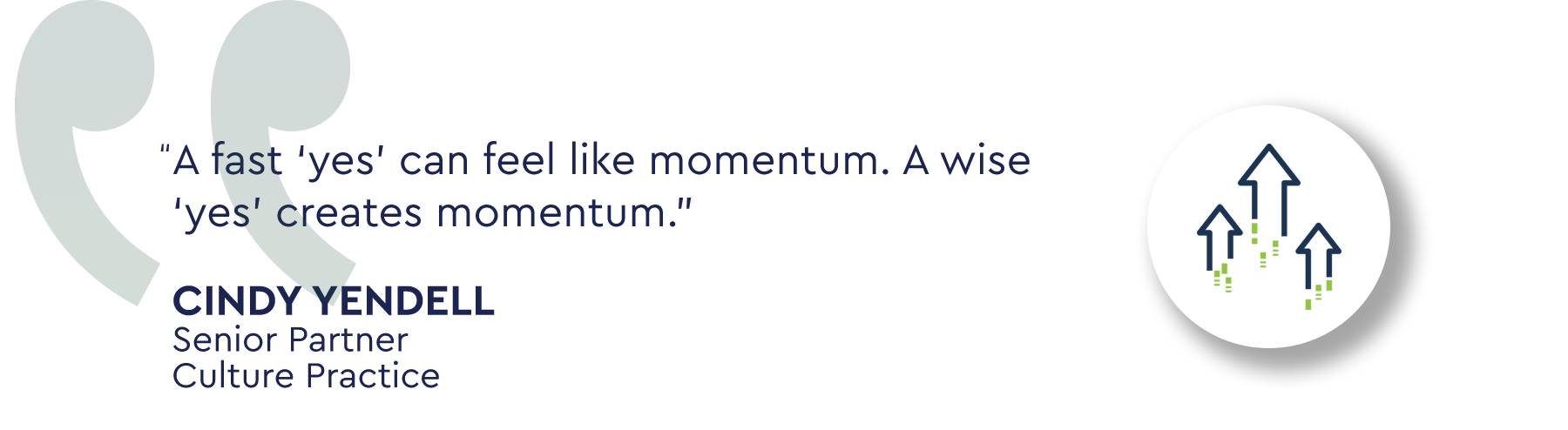
These conversations may feel uncomfortable. They may even appear to slow things down. In practice, they can do the opposite: they replace assumption with clarity before work begins. A fast “yes” can feel like momentum. A wise "yes" creates momentum.
Psychological safety and accountability are not opposites
This is where accountability and psychological safety become inseparable. Psychological safety is sometimes characterized as creating an environment where people feel comfortable speaking up. But its commercial value goes much further. Perhaps one of the real tests of psychological safety is whether people feel able to say “no” before they say “yes.” Can someone challenge an unrealistic deadline? Surface a risk? Admit that they don’t understand the expectation? Tell a senior leader that two competing priorities cannot both be delivered?
When they can, problems emerge while there is still time to solve them, rather than weeks later when options have narrowed. Far from weakening accountability, psychological safety can make accountability stronger.
Candor and dialogue before commitment reduces surprises after it.
Accountability doesn’t mean constant oversight
Of course, accountability doesn’t end once a promise has been made. But nor does it require leaders to monitor every activity. Effective leaders stay connected rather than controlling activity. They ask: What’s changed? What risks are emerging? Are we still on track to deliver what we agreed? What support do you need? The purpose isn’t to catch people out. It is to identify changes early enough to protect the outcome.
That distinction matters. Oversight asks whether people are busy. Accountability keeps the organization focused on whether the outcome is still achievable.
Individual accountability isn’t enough in a matrixed organization
This matters particularly as organizations become more matrixed and cross-functional. Projects rarely fail simply because one person hasn’t completed a task. More often, every function can deliver its individual contribution while nobody remains accountable for whether the organization collectively delivers the outcome.
That creates an organizational-wide accountability failure: every box is ticked, but the outcome is still missed.
High-performing organizations, therefore, create both individual and collective accountability:
"Have I delivered what I promised?" and "Have we delivered what we promised?"
The nuance: clarity does not remove responsibility
There is a risk in taking this argument too far. Better conversations should not become an excuse for endless negotiation, lowered expectations, or avoiding difficult performance decisions.
Sometimes the commitment was clear, the resources were available, and somebody simply did not deliver. Accountability still requires consequences.
But consequences work best when they follow genuine clarity. Leaders should be able to say: we agreed the outcome, understood the constraints, surfaced the risks and stayed connected as circumstances changed. Against that backdrop, holding someone accountable is both fairer and more effective.
The point is not to make accountability softer. It is to make it stronger.
From holding people accountable to creating accountability
Perhaps the biggest shift is one of mindset. Accountability shouldn’t primarily be something that happens to people when performance falls short. It should be something leaders and teams create together throughout the life of a commitment.
Seen this way, accountability is not synonymous with blame, control, or performance management. It is the discipline of creating clarity before commitment, maintaining honest dialogue during delivery, and learning afterwards. Gallup’s research suggests leaders are struggling with accountability. Perhaps the better question for leaders isn’t, “How do we hold people more accountable?” it’s, “What are we doing to create accountability before delivery is at risk?”
That means making success explicit. Giving people permission to negotiate priorities and constraints, staying close enough to commitments to see risks early, and making accountability about outcomes, not activity.
Accountability is not created when work is reviewed. It begins when a clear promise is made.
Build stronger accountability
Discover how we can help your leaders create clarity, strengthen accountability, and drive better results.
Let's connect.
Meet the Author