.webp)

.svg)
.svg)
.png)
Investment banking recruitment 2026: A mid-year review
Investment banking recruitment 2026: A mid-year review
Market signals
While senior investment banker movement has been slower than expected, there were still some clear patterns in the first half of 2026.
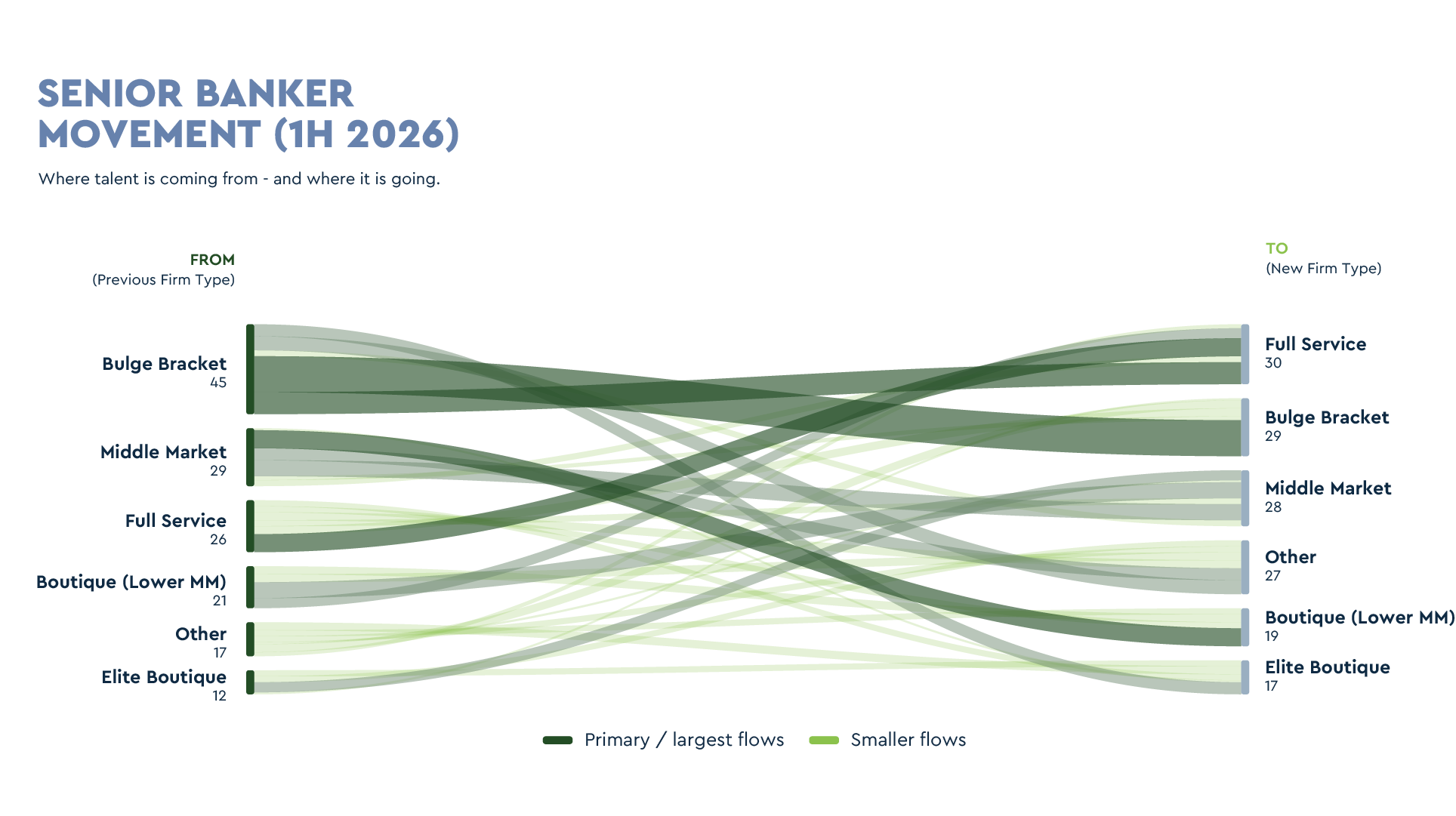
Based on a survey of 150 banker moves across platforms, the activity has been concentrated in lateral transitions and adjacent moves rather than step-change shifts.
Here are key patterns based on those banker moves:
- 18 bankers moved from a bulge bracket firm to another bulge bracket firm, representing the single largest flow in the market.
- Full service and bulge bracket firms were the most active on the hiring front with 20% and 19% of those senior banker additions, respectively.
Movement across smaller platforms remains active but largely very focused on specific sub-sectors. From a transaction perspective, we are hearing:
- Deal flow is improving but still not easy to get to transactions to the finish line.
- While large deals are getting announced, middle market transactions require very strong company fundamentals and performance.
- Backlogs are at historically high levels across many groups.
- Expectations for a stronger second half of the year are increasing.
While opportunity volume is increasing, candidate willingness to move remains constrained.
The takeaway: this is not purely a demand issue. It is a behavior shift.
Driving factors
1. Risk-off behavior is driving decision making
Bankers are sitting on real, actionable pipelines. That changes the calculus.
Leaving a platform now means walking away from active mandates and near-term revenue visibility. As a result, candidates are prioritizing certainty over upside.
This is reflected in the data, where the highest concentration of movement is within the same platform type.
2. Compensation is no longer a differentiator
Most bankers were generally satisfied with recent bonus outcomes.
At the same time, compensation structures across firms have converged. Competitive offers are expected, not compelling.
Offers today must do more than match economics. They need to mitigate risk and show clear upside beyond pay.
3. Platform strength matters more than ever
Bankers are increasingly focused on where they can win deals.
- Brand
- Product breadth
- Balance sheet
- Execution support
This is driving continued interest in full service and bulge platforms, which account for the largest inbound flows.
Without a clear platform advantage, it is difficult to move candidates.
4. Scale is limiting “lone wolf” moves
There is less appetite to build independently in the current environment.
Winning mandates requires coordinated coverage and integrated capabilities. Bankers are hesitant to move without the infrastructure needed to compete effectively.
5. Pipeline attachment is real
Backlogs are at or near peak levels in several verticals.
Bankers are reluctant to leave revenue that is already in motion. This is one of the most cited reasons for delayed or declined moves.
6. Leadership and role structure are situational
Leadership opportunities can be compelling but are highly candidate dependent.
Some bankers want to build and lead. Others prefer to remain focused on production without additional management complexity.
Investment bank responses
We are starting to see a reactivation of recruiting activity.
- Select firms that paused searches earlier in the year are returning to market.
- Activity has picked up in the last 4–6 weeks.
- There is increased urgency to secure talent ahead of a potentially stronger H2.
At the same time, firms are becoming more selective and more deliberate in:
- Defining the role.
- Aligning internally on expectations.
- Positioning the opportunity.
The shift: firms understand that simply “going to market” is not enough.
Talent implications
1. Differentiation is now the primary challenge
The constraint is not access to talent. It is giving candidates a compelling enough reason to move.
Compensation alone will not get it done.
2. The pitch matters more than ever
Firms need a clear, consistent story across:
- Platform
- Strategy
- Leadership
- Growth opportunity
- Consistency in the message
Misalignment internally shows up quickly and derails processes.
3. Process is a competitive advantage
An interview is now a two-way sales process.
Candidates are evaluating conviction, clarity, and decision-making speed. Slow or disjointed processes create doubt and increase drop-off risk.
4. Risk mitigation must be built into the offer
Candidates are focused on downside protection.
Successful processes address:
- Pipeline transition
- Platform support
- Near-term earnings visibility
5. Relationships are a long cycle
Many successful hires are the result of years of relationship building not opportunistic processes.
Recruiters that have real long-term candidate and client relationships are the most effective.
Firms that invest early in the candidates and build trust are better positioned when candidates are ready to move.
6. Flexibility on level can drive hiring outcomes
While firms often prefer to hire “proven” revenue generators, hiring talented up-and-comers can lead to outsized rewards for banks that invest in their development.
Emerging trends
- Continued concentration of movement within same-platform categories
- Increased flow back into full service and bulge bracket environments from boutiques, private equity or corporates
- Reduced willingness to move without a clear platform or brand step-up
- Growing importance of pipeline visibility in career decisions
- Re-acceleration of recruiting activity heading into the second half of the year
- Having trusted relationships is a key differentiator
Meet the Author



Jill Feldman
Managing Director
.webp)


.svg)
.svg)




.webp)