.webp)

.svg)
.svg)

The data center talent supply chain
The data center talent supply chain
Why Workforce Strategy Is Now the Data Center Industry's License to Build
A white paper from Matt Corbett, ZRG Partners Data Center Practice
Executive Summary
The data center industry is being squeezed by two constraints at once, and yet these constraints are being managed as if they are unrelated.
The first is labor. The construction phase of the AI build-out - the electricians, HVAC and mechanical trades, pipefitters, commissioning engineers, and project managers who turn capital into capacity - is now the scarcest input in the value chain. It takes longer today to hire an electrician than a software developer. Yet our own July 2026 analysis of open roles across 74 companies in the data center value chain found that trades and construction positions make up barely a sixth of the ecosystem's public job postings - not because the demand is small, but because it is procured invisibly through contractors and subcontractors, where no one forecasts or manages it. Hyperscalers that reserve transformer production slots two years in advance and pre-negotiate GPU allocations still procure their most constrained resource, skilled labor, on the spot market: requisition by requisition, project by project, poaching crew by poaching crew.
The second is trust. Community opposition has shifted from a nuisance to a primary execution risk. Billions of dollars in projects have been delayed or blocked by local resistance, moratoriums have spread to more than a hundred municipalities, and polling now shows Americans more opposed to a data center next door than to a nuclear plant. A major driver of this collapse in trust is the industry's narrative around jobs - a story that independent research shows was overstated by roughly a factor of three, and that communities have learned to discount.
This paper will argue that these two problems have a single answer. Operators and developers that treat talent as a supply chain - forecast against the site pipeline, forward-funded years before ground-break, deliberately localized, and committed to publicly and enforceably - will simultaneously solve their labor bottleneck and rebuild the credibility that permitting now requires. Workforce strategy has quietly become siting strategy. Recruiting is no longer a back-office function that fills requisitions after the shovel hits the ground. It is a license to build.
1. Two Crises Arrived in the Same Quarter
Consider what the first half of 2026 looked like from inside a data center development program. On the demand side, the largest hyperscalers committed roughly $700 billion in combined capital expenditure for the year, much of it flowing into new campuses. All of these campuses require electrical distribution, precision cooling, redundant power, and structured commissioning at a density and complexity with no real precedent in commercial construction. Electrical work alone accounts for an estimated 45 to 70 percent of total data center construction cost, according to the International Brotherhood of Electrical Workers.
On the supply side, demand far exceeded worker availability. The Associated Builders and Contractors estimated the construction industry would need roughly 349,000 additional workers in 2026 and 456,000 by 2027 just to meet demand. The National Association of Manufacturers projected a shortfall of 1.9 million manufacturing workers by 2033. Randstad's analysis of tens of millions of U.S. job postings found that demand for skilled trades grew 27 percent in four years - with robotics technician postings up more than 100 percent, HVAC and cooling engineers up 67 percent, and construction roles up 30 percent. Skilled-trades wages rose 30 percent over the same window. For the first time in the digital era, staffing analysts report that filling an HVAC or electrical role takes longer than filling a software engineering role.
And then, in the same quarter, the politics turned. In March 2026, federal legislation was introduced to pause all new large-scale AI data center construction. More than a hundred local communities had already enacted moratoriums; hundreds of state-level data center bills were filed in the first weeks of the year; and states that once competed to offer the largest incentives - Virginia, Georgia, Oklahoma - began reconsidering those programs. Industry trackers counted tens of billions of dollars in projects delayed, downsized, or cancelled due to permit conflicts, litigation, and organized opposition, with one analysis attributing roughly $130 billion in affected investment to community backlash in the first quarter of 2026 alone. Gallup found that 71 percent of Americans would oppose a data center near their home - a higher share than oppose a nearby nuclear power plant.
Inside most organizations, these two crises are owned by different departments. The labor shortage belongs to HR, talent acquisition, and the general contractor. The community backlash belongs to government affairs, communications, and legal. They hold different meetings, report to different executives, and rarely appear in the same risk register.
That org chart is the problem. This is one crisis with two symptoms - and the treatment for both runs through the same discipline: workforce strategy.
2. Construction Is Where the Build-Out Actually Breaks
The industry has spent three years debating its binding constraint - chips, then power, then capital. Each is real. But each of those constraints is being managed with sophisticated, forward-looking procurement, while the constraint that gates all of them is not.
A transformer that arrives on schedule still sits idle if there is no high-voltage crew to install and commission it. A substation energized on time feeds a building that cannot pass commissioning without controls specialists and mechanical trades. As the CEO of Randstad explained, the real constraint on global tech growth is not microchips, energy, or capital - it is the severe scarcity of the specialized talent required to build the physical foundation.
The structural math of the construction labor market makes this problem worse, not better, over the planning horizon that matters:
The pipeline is inverted. Industry analyses estimate that roughly 41 percent of the current construction workforce will retire by 2031, and in the skilled trades broadly, more young workers are leaving than entering. The United States needs on the order of 300,000 new electricians over the coming decade in addition to replacing roughly 200,000 expected retirements.
Turnover compounds scarcity. Overall construction turnover runs near 68 percent, climbing above 70 percent in the specialized trades that data centers need most. Every crew poached mid-project is not just a cost - it is a schedule risk on a facility where a single month of delay on a 60 MW build can represent roughly $14 million in lost revenue.
The competition is no longer just other builders. Data center projects now compete for the same certified electricians and mechanical specialists as semiconductor fabs, grid modernization, and defense industrial expansion. Workforce strategists describe active cross-industry poaching because the operational skill profiles overlap almost completely.
The premium is already priced in. Specialized professionals moving into data center roles command 25 to 30 percent pay increases, per staffing-industry data, and top trades in hot markets have crossed into six figures. Paying more works - for a single project, once. As a market-wide strategy, it simply bids up the same fixed pool of workers, strips labor from surrounding regional projects, and, as we will see, feeds the resentment that is now blocking permits.
The consequences are no longer hypothetical. JLL reported that 57 percent of North American data center construction projects experienced schedule slippage of three months or more, with labor cited as the primary cause in a majority of those cases. Construction firms specializing in data center work report declining projects for lack of qualified crews. One data center executive put the industry's near-term future plainly: the second half of 2026 into 2027 will see massive activation across the country, and the industry simply does not have enough qualified workers to meet it.
And the skills are shifting underneath the shortage. It would be one thing if the industry merely needed more of the trades it has always needed. However, the industry needs new ones. CB Insights' 2025 mapping of the data center value chain identifies liquid cooling as a baseline requirement for AI builds rather than a niche - venture funding for liquid cooling surged nearly fivefold year-over-year to $546 million - while a parallel wave of capital flows into on-site and behind-the-meter power: small modular reactors, grid-scale batteries, microgrids, and virtual-power-plant orchestration designed to bypass multi-year interconnection queues. Every one of these technologies arrives on a job site as a trade profile that barely existed three years ago: two-phase and direct-to-chip coolant systems, coolant distribution unit installation and maintenance, leak-tolerant plumbing at rack density, battery and microgrid electrical work, and - before the decade is out - nuclear-adjacent construction and commissioning. Virtually none of it is taught in today's trade school curricula. The industry is not just short of workers; it is short of workers for jobs the training system has not yet learned to produce.
Geography compounds all of it. The same value-chain analysis notes that AI capacity is consolidating with a small cohort of developers able to deliver multi-gigawatt campuses at speed - and these campuses are located where power and land are available, not where labor is. Five-gigawatt build-outs are now planned for rural West Texas and similar power-rich, people-poor geographies. In these labor sheds, the workforce the schedule assumes does not exist locally at any wage. It must either be imported at premium cost - the exact behavior communities resent - or manufactured in advance.
What the ecosystem's own job boards reveal. To ground this in primary data, in July 2026 our team took a hiring snapshot of 74 companies profiled in CB Insights' data center value chain - spanning power generation, AI chips, cooling and supporting infrastructure, networking, and facilities operators. Among the startups and scale-ups whose postings could be verified, roughly 1,300 to 1,500 roles were open, and their shape is revealing. Engineering and R&D dominate, at nearly six in ten postings. Field service, skilled trades, and construction/project management together account for only about 17 percent ecosystem-wide - but that share is intensely concentrated: within the facilities-and-operations sector it approaches 40 percent of postings, and it clusters further into a handful of names - the leading AI-optimized developer, and the nuclear and fusion power builders now standing up physical plants. In the AI chip and networking sectors, trades demand on careers pages is effectively zero. At first glance, 17 percent looks like a refutation of the labor thesis. However, it is actually the thesis in miniature. The construction workforce that will actually build the next five years of capacity barely appears on any operator's careers page, because it is procured invisibly - through general contractors, electrical and mechanical subcontractors, and staffing intermediaries - rather than employed directly. The single largest input to the build-out leaves almost no direct footprint in the demand data of the companies that depend on it. What cannot be seen on a job board does not get forecast, funded, or forward-contracted. That invisibility is not a data quirk. It is the management failure this paper is about.
Exhibit 1. Function shares from the ZRG Partners' 74-company hiring snapshot (July 2026, directional); cost shares from industry development-cost benchmarks.
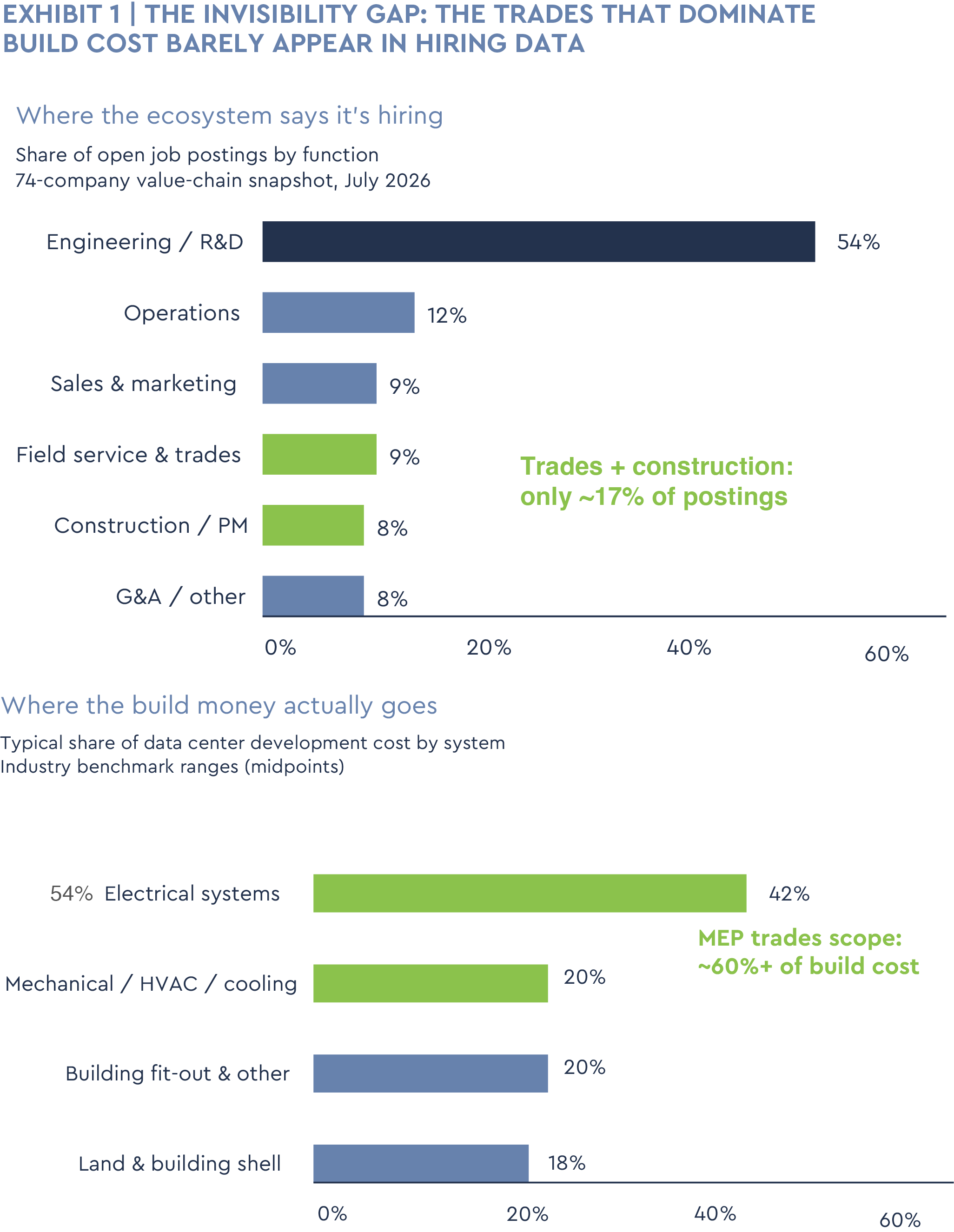
Sources: ZRG Partners Data Center Talent Demand Snapshot (July 2026, 74 companies; function splits directional; see methodology note); Dgtl Infra data center cost benchmarks (electrical 40–45%; mechanical ~20%).
Exhibit 1. Function shares from the ZRG Partners’ 74-company hiring snapshot (July 2026, directional); cost shares from industry development-cost benchmarks.
Capital is not the constraint. Neither, increasingly, is power. The constraint is a journeyman electrician in the right county in the right quarter - and no one is forward-contracting for her.
3. The Trust Deficit the Industry Built for Itself
If the labor shortage were the only problem, the industry could attempt to out-spend it. The second constraint forecloses that option - and the industry's own behavior helped create it.
For the past decade, the standard playbook for winning local approval has been a jobs announcement. Developers arrived with employment projections designed to justify tax abatements and rezoning, and for years it worked. Then communities started checking the math.
In 2026, researchers at Brookings published the first rigorous causal analysis of data center employment effects, covering roughly 770 U.S. facilities across 93 counties over two decades. The findings deserve honest treatment from our industry - including from recruiting firms like ours, whose business is these very jobs - precisely because they are more nuanced than either the industry's brochures or the opposition's talking points.
The uncomfortable half: naive industry-sponsored estimates overstate employment effects by roughly a factor of three, because data centers tend to be sited in counties that were already growing. Permanent operational headcount at a single facility is genuinely small - often dozens to a few hundred roles. Academic critics have called the jobs pitch a "significant false promise," noting that construction employment is temporary and crews are often imported from out of state. Communities have absorbed this critique. It shows up verbatim at zoning hearings.
The structure of the modern developer makes the skepticism worse. Today's leading platforms are shockingly asset-light in human terms: CB Insights' company data shows one major AI-optimized developer operating more than five gigawatts across fifty campuses - recently acquired at a $40 billion enterprise value - with a headcount of roughly 430. Another has raised over a billion dollars to build five gigawatts across five campuses, including the first Stargate site, with fewer than 80 employees. Our July 2026 hiring snapshot sharpens the picture: that first developer was advertising roughly 250 open positions - an attempt to grow its direct workforce by more than half in a single push, and one of the most aggressive hiring postures anywhere in the ecosystem. Yet even that surge is a rounding error against the thousands of construction tradespeople most campuses require, none of whom will ever appear on its payroll. When a company of that size promises a county an economic transformation, the county is right to be skeptical. The direct payroll will never justify the land, water, and power. The justification is the employment the developer orchestrates rather than holds - thousands of construction trades across a multi-year build, plus the regional services ecosystem that forms around clustered hyperscale investment. But that orchestrated employment only materializes, and only counts locally, if someone deliberately builds the local pipeline. Which is precisely the work the industry has not done.
The other half that many critics skip is that this same research found that data centers do create real local economic value, when the conditions are right. Counties receiving their first large data center see total private employment rise 4 to 5 percent over five to six years. Construction employment jumps 11 percent. Wages rise 3 to 4 percent for existing workers as well as new hires, without measurable housing-price inflation. Most strikingly, the effects depend on what gets built and how: hyperscale campuses drive 22 percent growth in local information-sector employment - the fiber installers, network operations, IT services, and managed providers that form a durable ecosystem - while colocation facilities, whose tenants are remote, largely do not. And counties that develop clusters of four or more facilities see information-sector employment gains of 23 percent, versus no significant ecosystem effect from a single isolated site.
This evidence clearly points to a conclusion the industry has not yet internalized: the credible jobs story is not a talking point that can be announced. It is an outcome that has to be constructed. The counties where data centers became genuine economic engines are the counties where local labor pipelines, clustered development, and supplier ecosystems actually formed. Where developers imported traveling crews, built one isolated box, and moved on, the critics are simply right.
The inflated jobs narrative was not just imprecise. It was strategically self-defeating: it handed the opposition its best argument, and it squandered the one benefit claim the industry could have defended with evidence. Rebuilding that credibility is not a communications exercise. It is a workforce exercise.
4. The Framework: Treat Talent as a Supply Chain
Here is the paradox at the center of this paper. Hyperscalers and developers run some of the most sophisticated procurement operations in the global economy. They reserve medium-voltage switchgear production slots up to 80 weeks out. They forward-purchase power a decade ahead. They pay schedule-certainty premiums to equipment suppliers and pre-qualify vendors against reference architectures years before ground-break - McKinsey has documented the entire discipline. Consulting analyses of the equipment side now explicitly warn suppliers to treat talent as a strategic investment rather than an operational input. Yet the buyers themselves - the operators and developers - still procure their scarcest input on the spot market. Labor planning starts when the general contractor mobilizes. Recruiting starts when the requisition opens. Our hiring snapshot makes the asymmetry measurable: the ecosystem's equipment and power needs are visible years out in reference architectures and reserved production slots, while its construction labor needs are visible almost nowhere - a 17 percent sliver of public postings standing in for the largest workforce in the build. The result is exactly what spot-market procurement of a constrained, unmeasured commodity always produces: price spikes, allocation fights, and delivery failure.
The asset-light structure of the industry makes this untenable, not optional. A developer with a few hundred employees and fifty campuses cannot solve a five-thousand-tradesperson problem internally even in principle; nearly all of its workforce lives outside its walls, spread across GCs, electrical and mechanical subcontractors, commissioning agents, and regional labor markets. That is not a staffing problem. That is a supply chain - and it deserves to be managed like one.
The alternative is to manage construction talent the way the same organizations already manage transformers. We call this the talent supply chain, and it has four pillars.
Pillar 1: Demand-signal planning
Translate the 3-to-5-year site pipeline into role-level labor forecasts by region - how many journeyman electricians, HVAC and controls technicians, pipefitters, and commissioning engineers, in which counties, in which quarters. Supply chain teams already do precisely this for long-lead equipment; the same build schedule contains the labor bill of materials. The forecast should account for regional saturation (three campuses drawing on one union hall is a knowable collision, not a surprise), for competing demand from fabs, grid work, and other industrial projects in the same labor shed - and for the technology roadmap itself. A campus designed around direct-to-chip liquid cooling and on-site generation carries a materially different labor bill than an air-cooled, grid-fed facility, and reference architectures signal those requirements years in advance, exactly as they do for equipment.
Pillar 2: Pipeline procurement
Reserve capacity in the talent supply chain the way you reserve capacity in the equipment supply chain - years ahead, with money. That means funded cohorts at trade schools and community colleges sized to the forecast; registered apprenticeships attached to your projects rather than generic programs; military-transition pipelines, which the industry's own operators cite as among their richest sources of data-center-ready skills; and re-skilling bridges from adjacent trades. Increasingly, it also means funding the curriculum, not just the seats: for the trades the technology roadmap is creating - liquid cooling installation and service, coolant distribution systems, battery and microgrid electrical work - there is no existing program to buy into, so the operators and their equipment partners must co-develop one, precisely as chipmakers co-developed reference architectures with their suppliers. It also means widening the aperture: Census data show data center employment grew more than 60 percent from 2016 to 2023 while carrying a persistent 20-to-30-point gender gap - which is not only an equity statistic but an under-recruited half of the labor pool. Capital has begun to move this direction at the top of the market: BlackRock committed $100 million to skilled-trades training after its CEO warned publicly that the country will run out of the electricians needed to build AI data centers. The operators who co-invest locally, early, will hold the allocation rights when the shortage peaks.
Pillar 3: Retention and redeployment
A hyperscale campus is not a one-year job site; multi-building campuses run construction arcs approaching a decade, and AI hardware's two-to-three-year refresh cycle generates continuous retrofit, recommissioning, and upgrade work long after initial delivery. That duration is a retention asset almost no one is using. Design explicit career ladders - apprentice to journeyman to commissioning specialist to operations technician - that carry workers across phases and buildings instead of losing them to a 20 percent raise at the project fence line. In a market with 70-plus percent turnover in specialized trades, the operator that keeps its crews compounds an advantage every quarter.
Pillar 4: Enforceable, public commitment
Convert the workforce plan into commitments a community can verify, such as local-hire percentages with real numbers, funded apprenticeship seats at named institutions, wage floors, and reporting. Community benefit agreements are already emerging as the practical instrument, and community advocates now explicitly coach local governments to demand exactly these provisions as conditions of approval. Operators can treat that as a concession extracted under pressure - or as the cheapest permitting insurance available. Informal pledges no longer buy trust; enforceability is precisely what makes a commitment worth something at a zoning hearing.
5. The Double Dividend: Workforce Strategy Is Siting Strategy
Pillar 4 is where the two crises converge, and where this framework pays twice. The proof point comes from the market leader, and it was learned the hard way. After local opposition defeated a proposed Microsoft data center in Caledonia, Wisconsin, the company launched a "Community-First AI" playbook - public pledges spanning electricity pricing, full tax payments, water stewardship, community investment, and, notably, workforce development. The lesson generalizes: the era in which capital and a jobs press release bought a permit is over. What buys a permit now is verifiable local benefit - and of all the benefits a data center can offer, a funded, visible, local talent pipeline is the one communities can watch materialize before the building even opens. Residents may never see the water recycling system. They will see their neighbor's kid in a paid apprenticeship. Consider what the talent supply chain does to each side of the ledger:
To the labor problem: it converts spot-market scrambling into reserved capacity, cuts time-to-fill on the roles that gate schedules, reduces the turnover tax, and insulates projects from regional poaching wars - because workers with a career ladder and local roots are the hardest to poach.
To the trust problem: it replaces the discredited jobs narrative with a demonstrable one. The Brookings evidence gives operators the honest script: real wage gains for existing residents, real construction employment, and - for hyperscale, clustered development with local pipelines - a genuine information-sector ecosystem. An operator who builds the pipeline can make those claims with receipts. And a community that hosts the pipeline acquires a stake in the project's success, which is the only durable antidote to organized opposition.
The strategic reframe for the industry is this: recruiting has become a site-selection discipline. The question "can we source 800 tradespeople in this labor shed across a six-year build?" belongs in the same diligence packet as power availability and fiber routes - and the question "will this community permit us?" is increasingly answered by how credibly we can commit to sourcing many of them locally.
6. Objections, Answered
"Construction jobs are temporary, and the crews get imported anyway." This is the opposition's strongest card, and it deserves a straight answer. Operators behind these projects are the ones making this statement true. Importing traveling crews is a procurement decision, not a law of nature - and it is precisely the decision the talent supply chain reverses. Meanwhile, "temporary" understates the arc: multi-phase campuses sustain construction employment for the better part of a decade, hardware refresh cycles generate permanent retrofit and upgrade work, and well-designed ladders move construction workers into the operations, maintenance, and commissioning roles that persist for the asset's life. The Brookings data showing 11 percent construction employment gains and durable wage effects for existing residents reflect places where that arc was allowed to happen.
"This boom will bust like housing did in 2008." The structural differences matter. Housing construction ended when the house was sold; data center construction feeds an operations-and-upgrade cycle that does not end, because the computing hardware inside becomes obsolete every two to three years. And the skills in question - high-voltage electrical, precision mechanical, controls - transfer directly to grid modernization, semiconductor fabs, and energy infrastructure, all of which face their own decade-long shortfalls. A worker trained for data centers is not stranded if data center demand moderates; an operator that trained them still banked the community goodwill.
"Hyperscalers have infinite money - they'll just pay their way out." Some industry economists say exactly this. But wage escalation is a single-project solution that worsens the market-wide problem in both dimensions at once: it strips labor from schools, hospitals, and housing projects in the region - feeding the "data centers take and don't give" narrative that fuels moratoriums - while raising every competitor's costs, including your own on the next site. Paying premiums for spot labor while community opposition blocks your next three permits is not a strategy. It is a treadmill.
7. Recommendations
For operators, developers, and hyperscaler infrastructure leadership, five moves:
- Move construction workforce planning into infrastructure governance. Labor forecasting belongs beside power procurement and equipment scheduling in the development stage-gate process - with a seat in site selection - not downstream in HR or delegated entirely to the GC.
- Forward-fund regional pipelines three to five years ahead of demand signals. Treat trade school cohorts, apprenticeships, and military-transition programs as reserved production capacity, sized to the site pipeline and located in the labor sheds where you intend to build.
- Make local-hire commitments specific, public, and enforceable. Vague pledges are now a liability; numbered, verifiable commitments in community benefit agreements are permitting currency. Publish progress.
- Design for retention across the campus arc. Build career ladders that carry workers from apprentice through commissioning into operations, and price the value of a retained crew against the true cost of 70 percent trade turnover.
- Measure and publish workforce outcomes with the same rigor as PUE. Local hires, apprenticeship completions, wage levels, retention. The industry lost the jobs debate because its numbers could not survive scrutiny. The remedy is numbers that can - reported before the community asks.
8. Conclusion: License to Operate Is Now License to Build
The data center industry solved chips with allocation contracts, is solving power with decade-long PPAs and behind-the-meter generation, and never doubted it could raise the capital. The two constraints that remain - workers and trust - cannot be solved with a purchase order, and they cannot be solved separately, because they are the same problem wearing two faces. Communities block projects partly because the jobs story stopped being believable; the jobs story stopped being believable because the industry never built the workforce machinery to make it true.
The operators who build that machinery now - who forecast labor like equipment, fund pipelines like production slots, and commit locally in writing - will find both the crews and the permits waiting. Those who keep treating recruiting as requisition-filling may discover, at some point in the next two years, that the labor market and the zoning board reached the same conclusion about them at the same time: already allocated, without them.
About ZRG Partners
ZRG Partners' Data Center Practice recruits across the full development ecosystem - land, power, design, construction, commissioning, and operations - with a specialized team focused on the construction trades and leadership roles that gate today's build-outs. Contact Matt Corbett at mcorbett@zrgpartners.com.
Sources and Notes
- McKinsey & Company, "The $7 trillion data center build-out: How industrials can capture their share," March 2026 (equipment lead times; talent as readiness constraint; supplier operating models).
- CB Insights, "Data Center Value Chain: Book of Scouting Reports," 2025 (value-chain taxonomy; liquid cooling funding growth; on-site power and VPP trends; developer capitalization and headcount data).
- ZRG Partners Data Center Talent Demand Snapshot, July 2026 (proprietary analysis of open job postings across 74 companies profiled in the CB Insights value chain; see methodology note).
- Bahar, D. & Wright, G., "New evidence on data center employment effects," Brookings Institution, May 2026 (employment causal estimates; hyperscale vs. colocation; cluster effects; incentive targeting).
- U.S. Census Bureau, "Employment in Data Centers Increased by More Than 60% From 2016 to 2023," January 2025 (QWI employment levels, geographic concentration, demographic composition).
- CNBC, "How the red-hot AI data center boom is igniting demand for a new, lucrative career path: Trade workers," March 2026 (Randstad job postings analysis; Kelly Services pay premiums; Mercer on cross-industry poaching; BlackRock trades initiative).
- Associated Builders and Contractors; National Association of Manufacturers (workforce shortfall projections).
- International Brotherhood of Electrical Workers (electrical share of data center construction cost); Fortune, March 2026 (electrician pipeline needs).
- JLL (2025 schedule-slippage analysis); industry labor-market reports (turnover, retirement, and delay-cost estimates).
- Dgtl Infra, "How Much Does it Cost to Build a Data Center?" (construction cost breakdown by system: electrical, mechanical/HVAC, shell, fit-out); used in Exhibit 1.
- Data Center Watch / industry trackers; Gallup, May 2026 (opposition polling); Data Center Knowledge, April 2026 (Microsoft Community-First AI Plan; Caledonia, WI).
- Sanders–Ocasio-Cortez AI Data Center Moratorium Act, introduced March 25, 2026.
Methodology note - hiring snapshot. In July 2026, ZRG Partners reviewed the public careers pages and applicant tracking systems of 74 companies profiled in CB Insights' data center value chain, classifying each open posting into six functions (engineering/R&D; field service & skilled trades; construction/project management; operations; sales & marketing; G&A/other). Verifiable postings among startups and scale-ups totaled approximately 1,300–1,500; roughly twenty companies' listings could not be confirmed and are excluded, and a small number of large multinationals in the sample were analyzed separately to avoid distorting the cohort. Counts are a point-in-time snapshot; function classifications for companies without parseable listing-level data are directional estimates. Figures should be treated as indicative of the shape of ecosystem hiring demand rather than a census of it.
Meet the Author





.svg)
.svg)




.webp)