.webp)

.svg)
.svg)
.png)
From succession planning to succession readiness
From succession planning to succession readiness
Boards that get leadership transitions right treat succession as a system, not an event.
This article is part two of a three‑part series on CEO succession readiness. In Part one, we explored why so many CEO transitions fail and what boards consistently underestimate about leadership readiness. Here, we shift from diagnosis to design. This article focuses on how boards move from static succession planning to a continuous readiness system that reduces risk, surfaces gaps early, and builds leadership capacity over time.
Here is the uncomfortable truth: most boards believe they have a succession plan, but very few have succession readiness
The difference is not subtle. A succession plan is a document. It is reviewed periodically, updated cautiously, and often filed away once the meeting ends.
A readiness strategy is a continuous practice. It is woven into how leaders are assessed, developed, and stretched over time.
One is episodic. The other is operational.
Why succession checklists create false confidence
It gives the appearance of control: a short list of candidates, a discussion once or twice a year, and agreement that the board is covered."
The problem is that checklists do not surface risk. They disguise it.
Checklists assume that tenure equals capability, performance equals preparedness, and stability equals readiness. None of those assumptions hold in a disrupted environment.
Readiness is dynamic. It changes alongside strategy, markets, and organizational complexity. Boards that fail to revisit readiness through a forward-looking lens discover gaps only once the transition is underway.
At that point, options are limited and credibility is already at risk.
Succession as a system
Boards that manage leadership continuity effectively stop treating succession as a future moment and start treating it as a present-day system.
That system includes:
- Capability forecasting that defines what leadership will need, not what it needed before
- Evidence-based assessment that measures readiness against future leadership demands, not just current role performance, and creates a consistent, comparable view of leadership capability across the pipeline.
- Pipeline visibility beyond the obvious candidates, informed by objective assessment rather than exposure alone.
- Cultural reinforcement that rewards development rather than politics or risk avoidance

Assessment is the mechanism that holds this system together. Without a consistent way to evaluate leadership against future requirements, boards are left comparing individuals based on role history, visibility, or perceived impact. That creates inconsistency and blind spots. When assessment is applied with rigor, it creates a shared language for readiness, surfaces gaps earlier, and allows boards to make decisions based on evidence rather than familiarity.
When succession becomes a system, the board gains something more valuable than a list. It gains early warning signals. They see where leadership strength is compounding and where development is stalling. They have time to act before the transition exposes weaknesses.
Six questions boards should be asking
Boards that are serious about shifting from planning to readiness should pressure-test their approach with these questions:
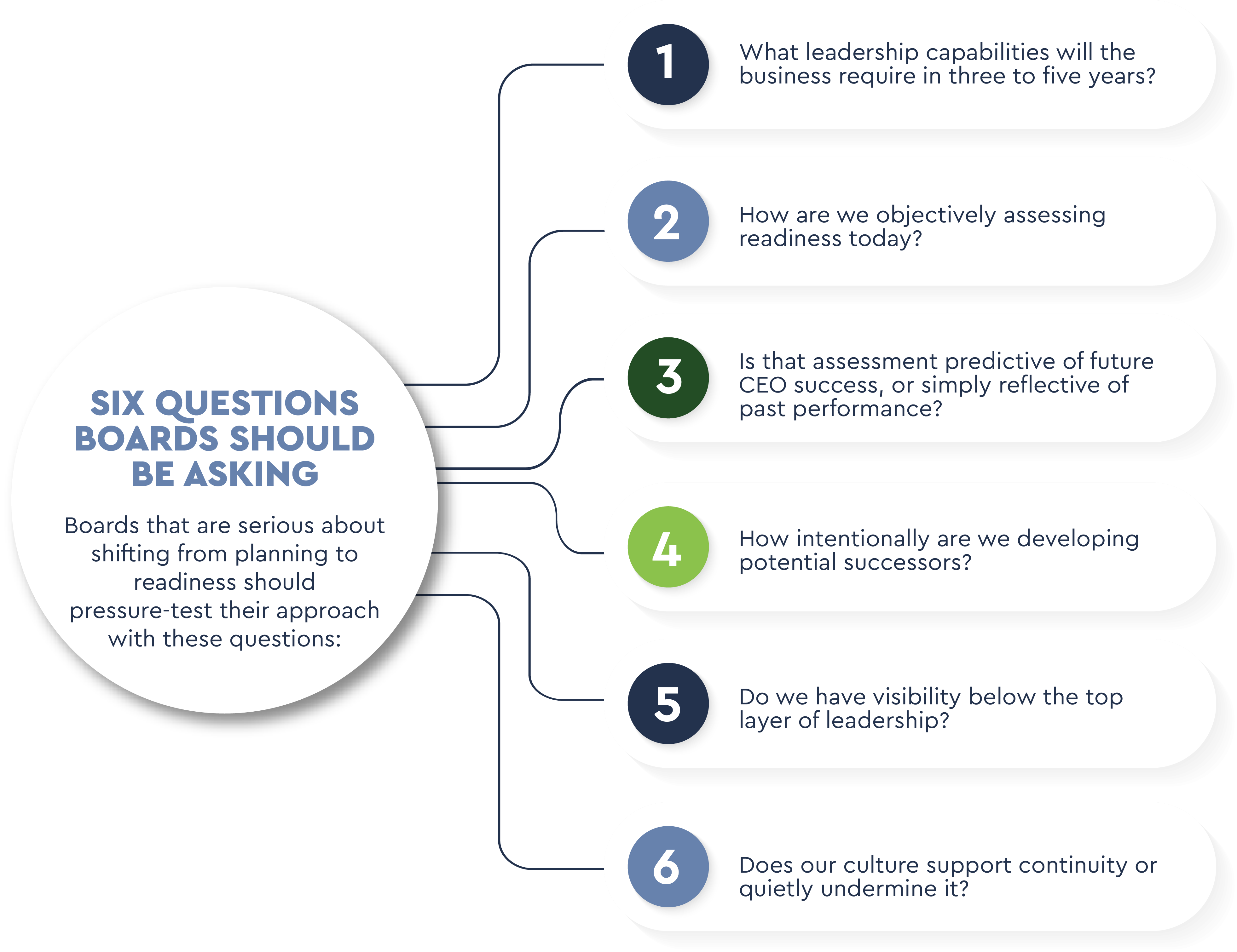
- What leadership capabilities will the business require in three to five years?
- How are we objectively assessing readiness today?
- Is that assessment predictive of future CEO success, or simply reflective of past performance?
- How intentionally are we developing potential successors?
- Do we have visibility below the top layer of leadership?
- Does our culture support continuity or quietly undermine it?
These questions do not guarantee success. But boards that avoid them almost guarantee disruption.
In Part three of this series, we turn to execution. We explore how boards actually close readiness gaps once they are identified, where executive coaching fits, and why it works only when used with rigor and intent.
Meet the Author





.svg)
.svg)




.webp)